
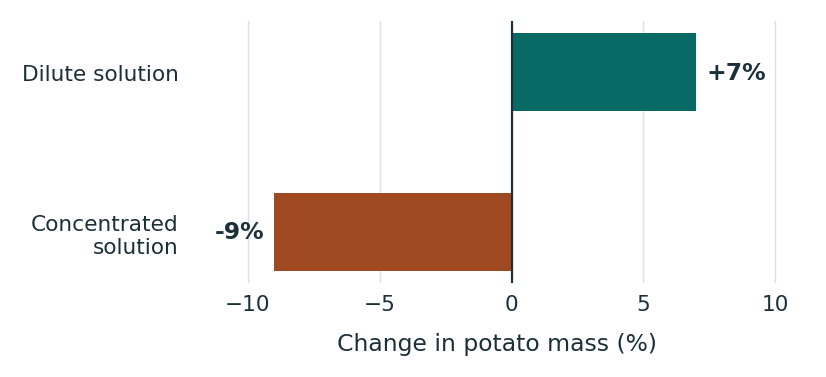
Start here. Which potato sample gained mass? Which lost mass? Read each percentage from the graph.
Now explain. Use both results to explain the mass changes. What else would you measure to find where the mass stays the same?
First time? Look at the worked example before you plan.
See a worked example
Example question: Amylase makes the same amount of product in 80 seconds at 15 °C and in 26 seconds at 35 °C. Everything else stays the same. At which temperature is the reaction faster? Explain why.
Topic sentence: Amylase worked faster at 35 °C across the two temperatures tested.
Supporting notes: 26 s vs 80 s → same amount of product → faster rate → higher kinetic energy → more frequent successful collisions → more enzyme–substrate complexes per second.
Concluding sentence: The comparison does not establish the optimum.
Amylase worked faster at 35 °C across the two temperatures tested. The same amount of product formed in 26 seconds at 35 °C and in 80 seconds at 15 °C. Producing the same amount in less time gives a greater mean rate. At the higher temperature the enzyme and substrate molecules move faster on average. This increases the frequency of successful collisions and more enzyme–substrate complexes form per second. We would need results from more temperatures to identify the optimum.
Plan your paragraph
Start with what the results show. In your notes, pair each result with the direction water moved. End with what you would test next.
Help
This is the first sentence of your paragraph. Say the main idea and link it to the question. Try: “The results show that …”
Help
Evidence is what you measured or observed. Reasoning is the science that explains why the evidence supports your answer. Jot down a result with its unit, then add an arrow and the reason it matters.
Help
Finish by answering the question or saying what your evidence lets you conclude. If the question asks what to do next, name the next test.
Write your paragraph
Help
Turn your notes into complete sentences. Put your main idea first, then add your supporting sentences. Use links such as “because”, “so” or “however” where they show how ideas fit together. Finish with your concluding sentence. Write it all as one paragraph.
Use these prompts to check what your sentences mean. The checker looks for words or values in your draft.
Your draft stays in this tab.
Compare with the key ideas
- Did you use both results? The potato gained 7% in dilute solution and lost 9% in concentrated solution.
- Did you link the gain to net water movement into cells and the loss to net water movement out of cells?
- Did you explain that osmosis is the net movement of water through a partially permeable membrane from a more dilute to a more concentrated solution?
- Did you suggest testing intermediate sugar concentrations to find where there is no net change in mass?